

Prompt 1 – Click to see
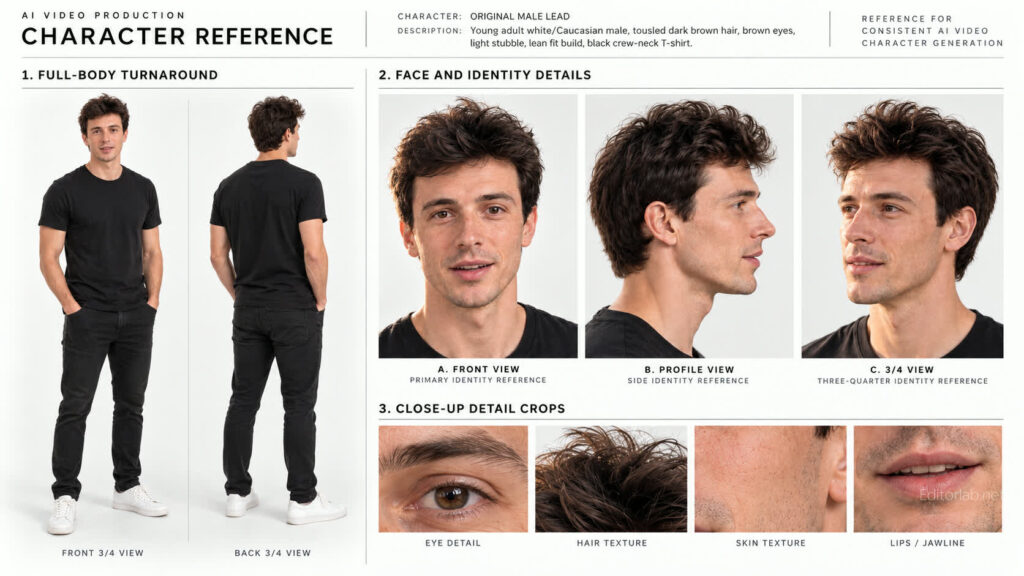
Create a professional AI Video Production — Character Reference Sheet for the provided character image or description. Create a polished 16:9 landscape continuity sheet focused exclusively on the character:
1. FULL-BODY TURNAROUND — a front three-quarter full-body view, and a back three-quarter full-body view of the exact same character at matching scale, with identical facial features, hairstyle, body proportions, costume, colors, and accessories.
2. FACE AND IDENTITY DETAILS — front, profile, and 3/4 head-and-shoulder close-ups showing facial structure, eyes, eyebrows, nose, lips, hairstyle, skin tone, makeup, scars, tattoos, and other defining features.
3. STYLE — ultra-realistic, imperfection, show natural skin detail, natural hair texture, natural beard. Use a clean white or neutral studio background, soft controlled lighting, realistic materials, sharp details, subtle shadows, clean typography, thin dividers, balanced spacing, and a sophisticated editorial production-design grid. Every panel must depict the exact same character with absolute visual consistency. Focus only on the character.
Prompt 2 – Click to see
Create a professional AI Video Production — Character Reference Sheet for the provided character image or description. Create a polished 16:9 landscape continuity sheet focused exclusively on the character:
- CHARACTER PROFILE — name, role, approximate age, height, body type, personality, distinctive traits, and signature colors.
- FULL-BODY TURNAROUND — front, 3/4 and side views of the exact same character at matching scale, with identical facial features, hairstyle, body proportions, costume, colors, and accessories.
- FACE AND IDENTITY DETAILS — front, profile, and 3/4 head-and-shoulder close-ups showing facial structure, eyes, eyebrows, nose, lips, hairstyle, skin tone, makeup, scars, tattoos, and other defining features.
- EXPRESSION SHEET — neutral, happy, sad, surprised expressions. Preserve the exact same facial structure and identity in every expression.
- COSTUME DETAILS — close-ups of clothing layers, fabrics, seams, fasteners, footwear, jewelry, eyewear, markings, logos, and other character-defining wardrobe elements.
- COLOR AND MATERIAL PALETTE — include 4–6 key colors with HEX codes, plus references for skin, hair, fabric, leather, metal, plastic, armor, or other visible materials.
- DO NOT CHANGE — lock the character’s face, identity, skin tone, age, hair, eye color, body shape, proportions, costume, accessories, markings, colors, and defining features. Do not redesign, beautify, age, stylize, simplify, or create alternate versions.
- STYLE — ultra-realistic, imperfection, show natural skin detail, natural hair texture, natural beard.
Use a clean white or neutral studio background, soft controlled lighting, realistic materials, sharp details, subtle shadows, clean typography, thin dividers, balanced spacing, and a sophisticated editorial production-design grid.
Every panel must depict the exact same character with absolute visual consistency. Focus only on the character.
Do not include props, additional characters, environments, unrelated objects, or alternate outfits. No waxy look.

Prompt 3 – Click to see
[ROLE]
You are a professional character continuity designer for cinematic AI video production.
Create a high-end, ultra-realistic CHARACTER REFERENCE SHEET based on the uploaded character reference image(s) or the written character description.
The purpose of this sheet is to establish a reliable visual identity reference for generating the exact same character consistently across future AI images and videos.
[CHARACTER INPUT]
Use ONE of the following:
A. IMAGE-BASED:
Use the uploaded image or images as the primary identity reference.
Analyze and preserve the character’s exact facial identity, facial proportions, age, skin tone, hairstyle, hairline, hair color, eye color, body proportions, build, facial hair, wardrobe, accessories, and distinctive physical traits.
B. DESCRIPTION-BASED:
Character description:
[INSERT CHARACTER DESCRIPTION HERE]
When working from a written description, create one definitive character design and maintain it identically across every panel.
[IDENTITY LOCK — CRITICAL]
Every representation must depict THE EXACT SAME PERSON.
Strictly lock:
- facial structure and proportions
- skull and jaw shape
- eyes, eyelids, eyebrows, and eye spacing
- nose shape and proportions
- lips and mouth shape
- ears
- skin tone
- age
- hairline
- hairstyle
- hair length, density, texture, and color
- facial hair pattern and density
- neck proportions
- shoulder width
- body type
- height impression
- limb proportions
- wardrobe
- footwear
- accessories
- scars, freckles, moles, wrinkles, tattoos, and other defining details
Do not beautify, redesign, stylize, rejuvenate, age, masculinize, feminize, idealize, or create alternate versions of the character.
Preserve natural asymmetry and real-world imperfections.
[OUTPUT FORMAT]
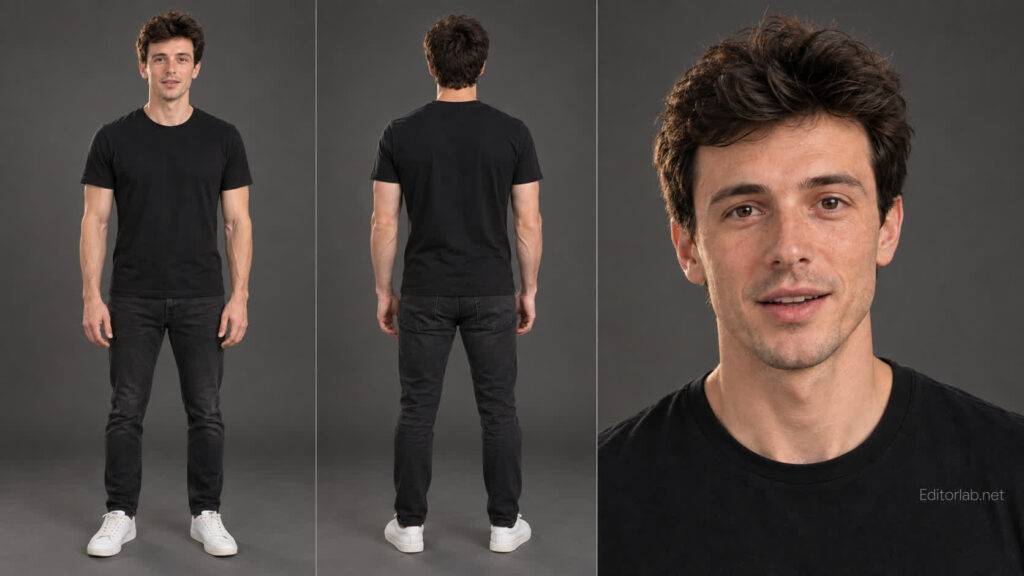
Create one polished 16:9 landscape character reference sheet.
Use a sophisticated cinematic production-reference layout.
The composition contains THREE dominant character views:
LEFT SECTION:
Two full-body turnaround views displayed side by side at matching scale.
- FRONT FULL-BODY VIEW
Character standing naturally, facing the camera.
Entire body visible from head to footwear.
Neutral relaxed posture.
Arms resting naturally or following the wardrobe/reference pose.
No exaggerated posing. - BACK FULL-BODY VIEW
Exact same character photographed from directly behind.
Same body scale, stance, wardrobe, footwear, proportions, and lighting as the front view.
The back of the hairstyle, clothing construction, silhouette, shoulders, waist, legs, and footwear must be clearly visible.
RIGHT SECTION:
One large FACE / IDENTITY CLOSE-UP occupying approximately 40% of the sheet.
- FACE IDENTITY PORTRAIT
Head-and-shoulders or tight portrait.
Slight three-quarter orientation toward camera unless the reference establishes another stronger identity angle.
Eyes clearly visible.
Neutral or subtly serious expression.
Face large enough to clearly study identity.
The portrait must reveal:
- forehead
- eyebrows
- eye shape and eye color
- eyelids
- nose structure
- cheeks
- lips
- jawline
- ears where visible
- hairline
- hairstyle
- facial hair
- skin texture
- age lines
- pores
- freckles, moles, scars, pigmentation, and natural imperfections when present
[WARDROBE CONTINUITY]
Use the exact same outfit across the full-body views.
If wardrobe is visible in the uploaded reference, reproduce it accurately.
If wardrobe is specified in the written description, follow it precisely.
Maintain identical:
- garment type
- cut and fit
- layering
- materials
- seams
- fasteners
- pockets
- sleeves
- pant shape
- footwear
- gloves
- jewelry
- eyewear
- accessories
- colors
Do not introduce logos, text, badges, name tags, graphics, or accessories unless explicitly present in the reference or requested by the user.
[POSE & PERFORMANCE]
This is a production reference sheet, not a fashion editorial.
Use restrained, neutral posing.
Character should appear:
natural,
grounded,
physically believable,
relaxed but alert.
Avoid dramatic gestures, action poses, exaggerated facial expressions, glamour posing, or artificial model poses.
[BACKGROUND]
Use a simple seamless professional studio environment.
Dark neutral charcoal-gray, muted gray, or another understated neutral background appropriate to the character.
Background must remain clean and distraction-free.
No scenery.
No furniture.
No environmental props.
No decorative objects.
The character is the only visual subject.
[LIGHTING]
Professional controlled studio photography.
Soft directional key light with subtle fill.
Natural dimensional facial modeling.
Gentle separation from background.
Soft realistic shadows.
Maintain identical lighting direction and color temperature throughout all panels.
Do not use dramatic colored lighting, excessive rim lights, beauty lighting, or artificial glow.
[CAMERA & OPTICS]
Full-body views:
approximately 50–70mm full-frame equivalent.
Camera around chest-to-waist level with minimal perspective distortion.
Natural human proportions.
No wide-angle stretching.
Face portrait:
approximately 85–105mm full-frame equivalent portrait lens.
Realistic facial compression.
Camera approximately eye level.
Sharp focus on character.
Natural depth of field.
No artificial background blur effects.
[PHOTOREALISM]
Ultra-realistic professional studio photography.
Prioritize believable human detail over perfection.
Show:
- real skin pores
- subtle wrinkles
- fine facial hairs
- beard or stubble texture
- natural hair strands
- flyaway hairs
- subtle skin discoloration
- realistic under-eye texture
- natural facial asymmetry
- realistic fabric weave
- realistic garment folds
- physically accurate material response
The character must look like a real photographed human being, NOT a 3D render or synthetic AI model.
[COLOR & MATERIAL]
Natural skin color.
Accurate wardrobe colors.
Neutral professional color grading.
Realistic contrast.
Soft highlight roll-off.
No excessive HDR.
No oversaturation.
No plastic skin.
Materials must behave realistically:
cotton looks like cotton,
nylon looks like nylon,
leather looks like leather,
metal reflects naturally.
[LAYOUT]
Landscape 16:9.
Approximate composition:
| FRONT FULL BODY | BACK FULL BODY | LARGE FACE CLOSE-UP |
Front and back figures should share the same visual scale and floor line.
Use subtle spacing or very thin neutral dividers between panels.
The face portrait should be substantially larger than the full-body views so facial identity can be inspected clearly.
Keep generous negative space and a professional production-reference aesthetic.
[TEXT]
No text.
No labels.
No titles.
No measurements.
No logos.
No graphic icons.
No watermarks.
The final sheet should consist only of the character views and minimal panel separation.
[CONTINUITY CHECK]
Before producing the final image, verify:
The face is identical in every view.
Hairline is identical.
Hairstyle is identical.
Facial hair is identical.
Skin tone is identical.
Age is identical.
Body proportions are identical.
Wardrobe is identical.
Footwear is identical.
Accessories are identical.
No unexplained design changes appear between views.
[EXCLUSIONS]
Do not:
- create multiple different-looking people
- alter facial identity between panels
- change hairstyle
- change hair density
- change facial hair
- change body shape
- change character age
- change skin tone
- change wardrobe between views
- add unnecessary accessories
- add text or logos
- smooth the skin excessively
- make the character look like CGI
- create doll-like skin
- use anime, illustration, painting, or concept-art styling
- crop the feet
- crop the top of the head
- distort hands or anatomy
- use extreme wide-angle perspective
FINAL GOAL:
A clean, cinematic, ultra-realistic character continuity sheet showing the exact same person from front, back, and a highly detailed facial identity view, suitable as a master reference for consistent AI video generation.
Leave a Reply